

If you’ve ever wanted to impress your family or friends with a dessert that looks like it came straight out of a fancy bakery but is actually doable at home, you need to try this pavlova recipe.
Pavlova is a light, airy meringue dessert with a crisp outer shell and a marshmallow-soft inside. It’s topped with sweetened whipped cream and fresh fruit, making it the perfect balance of sweet, creamy, and tart. I still remember the first time I made pavlova—it looked intimidating, but once I broke down the steps, it quickly became one of my favorite go-to desserts.
In this post, I’ll walk you through everything: the exact ingredients, step-by-step instructions, substitutions, common mistakes to avoid, and even some fun variations. Whether it’s for a holiday dinner, a birthday, or just a weekend treat, you’ll love how this dessert turns out.
Why You’ll Love This Recipe
- Crispy outside, marshmallow inside: The texture is unlike any other dessert—airy and light but with a chewy bite.
- Elegant presentation: Top it with whipped cream and fresh berries, and it looks like something straight out of a magazine.
- Naturally gluten-free: Perfect for serving guests with dietary restrictions.
- Customizable: Change up the toppings with lemon curd, chocolate drizzle, or seasonal fruit.
- Make-ahead friendly: You can prepare the meringue shell a day in advance and assemble just before serving.
This is more than just a meringue dessert—it’s a showstopper that’s surprisingly easy once you understand the basics.
Ingredients You’ll Need
Here’s what you’ll need to make this classic pavlova recipe:
- 4 large egg whites (room temperature, for best volume)
- 1 cup caster sugar (or superfine sugar, helps dissolve quickly)
- 1 teaspoon white vinegar (stabilizes the egg whites)
- 1 teaspoon cornstarch (helps keep the inside marshmallowy)
- 1 teaspoon vanilla extract (for flavor)
Toppings
- 1 cup heavy cream (cold, for whipping)
- 2 tablespoons granulated sugar (to sweeten the whipped cream)
- 1 teaspoon vanilla extract
- Fresh fruit (berries, kiwi, passionfruit, or your favorites)
Pro tip: Always make sure your mixing bowl and whisk are completely grease-free—any fat will stop your egg whites from whipping up properly.
Ingredient Substitutions
- Sugar: If you don’t have caster sugar, pulse granulated sugar in a food processor until fine. Avoid powdered sugar—it contains cornstarch and will change the texture.
- Vinegar: Lemon juice works just as well as white vinegar. Both help stabilize the egg whites.
- Cornstarch: You can swap with arrowroot powder for a similar effect.
- Whipped cream: For a dairy-free version, use coconut cream. It adds a subtle tropical flavor.
- Fruit toppings: Fresh berries are traditional, but mango, pineapple, or even lemon curd are fantastic twists.
How to Make Pavlova Recipe
Here’s the step-by-step guide to ensure your pavlova comes out crisp on the outside and soft on the inside.
Step 1: Preheat and prepare (10 minutes)
- Preheat your oven to 250°F (120°C).
- Line a baking sheet with parchment paper. Draw an 8-inch circle as a guide (optional).
Step 2: Whip the egg whites (5–7 minutes)
- Place egg whites in a clean, dry mixing bowl.
- Using a stand mixer or hand mixer, beat on medium speed until soft peaks form.
Step 3: Add sugar gradually (5 minutes)
- Increase to medium-high speed.
- Add sugar 1 tablespoon at a time, beating well after each addition. This ensures it dissolves completely.
- Beat until stiff, glossy peaks form and you can rub the mixture between your fingers without feeling sugar grains.
Step 4: Add stabilizers (2 minutes)
- Gently fold in vinegar, cornstarch, and vanilla extract with a spatula.
Step 5: Shape the pavlova (5 minutes)
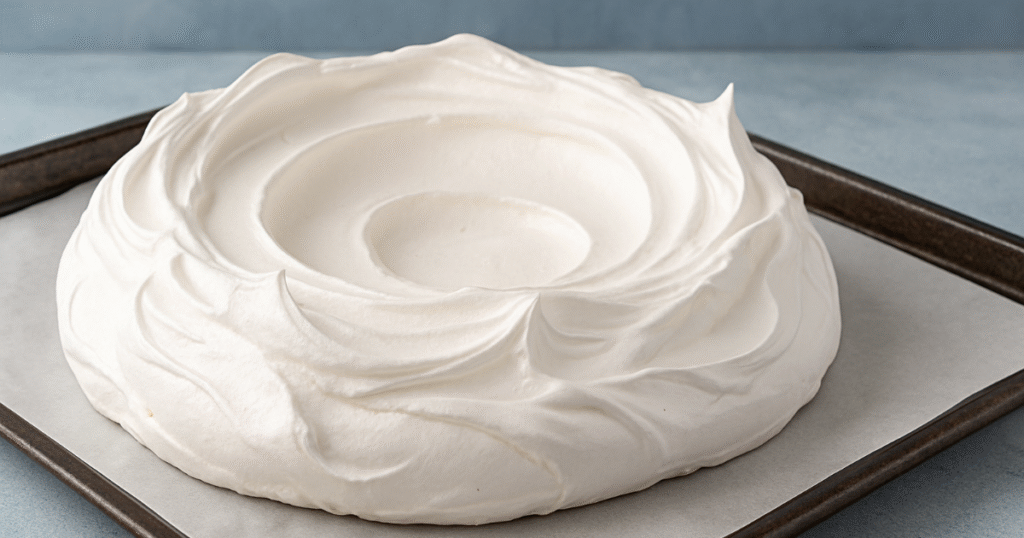
- Spoon the meringue onto the prepared baking sheet inside your drawn circle.
- Use a spatula to shape into a round with a slight dip in the center (to hold cream and fruit later).
Step 6: Bake low and slow (1 hour 15 minutes)
- Place in the oven and immediately reduce the temperature to 225°F (110°C).
- Bake for 1 hour 15 minutes, until the outside is crisp but not browned.
- Turn off the oven and let the pavlova cool completely inside with the door slightly ajar. (This prevents cracking.)
Step 7: Make the whipped cream (5 minutes)
- In a chilled bowl, beat heavy cream, sugar, and vanilla until soft peaks form. Don’t overwhip—it should be smooth and spreadable.
Step 8: Assemble and serve (5 minutes)
- Transfer cooled pavlova to a serving plate.
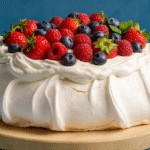
- Top with whipped cream and fresh fruit.
- Serve immediately for best texture.

Expert Tips and Common Mistakes to Avoid
- Use room temperature egg whites: They whip up more easily and give more volume.
- Don’t rush the sugar: Add it slowly so it dissolves completely. Grainy meringue = collapsed pavlova.
- Low and slow baking: High heat will brown or crack the pavlova. Gentle heat is key.
- Cool in the oven: Taking it out too quickly can cause major cracks.
- Make ahead: Bake the shell a day ahead, store in a dry place, and add toppings right before serving.
Variations & Add-Ons
- Mini Pavlovas: Make smaller individual portions—perfect for dinner parties.
- Chocolate Pavlova: Fold in 2 tablespoons cocoa powder before shaping. Top with chocolate shavings.
- Lemon Curd Pavlova: Add a layer of lemon curd under the whipped cream for extra tang.
- Tropical Pavlova: Use coconut cream for the topping and add mango, pineapple, and passionfruit.
- Christmas Pavlova: Decorate with red berries, kiwi, and pomegranate seeds for festive colors.
Serving Suggestions
- Serve with fresh fruit and sweetened whipped cream for a classic presentation.
- Add a drizzle of lemon curd or chocolate sauce for a twist.
- Pair with a cup of coffee or tea for an afternoon treat.
- It makes the perfect holiday dessert centerpiece—beautiful enough for Christmas, Easter, or even Thanksgiving.
Storage & Reheating
- Storage: Keep the pavlova shell at room temperature in an airtight container for up to 2 days. Avoid the fridge—it creates moisture and softens the shell.
- With toppings: Once topped, pavlova is best eaten the same day. Leftovers can be refrigerated, but the meringue will soften.
- Freezing: You can freeze the meringue shell for up to a month. Wrap tightly in plastic wrap and then foil. Thaw at room temperature before adding toppings.
Nutrition Information (per serving, 8 servings)
- Calories: 280
- Protein: 3 g
- Carbs: 40 g
- Fat: 12 g
- Sugar: 35 g
- Fiber: 1 g
- Sodium: 45 mg
Prep, Cook & Total Time
- Prep Time: 20 minutes
- Cook Time: 1 hour 15 minutes
- Total Time: 1 hour 35 minutes + cooling time
Frequently Asked Questions
Can I make pavlova ahead of time?
Yes. Bake the shell up to 24 hours ahead and store it in an airtight container at room temperature. Add whipped cream and fruit just before serving.
Why does my pavlova crack?
Cracks are usually from rapid temperature changes or a too-hot oven. Let the pavlova cool in the turned-off oven with the door slightly ajar to minimize cracking.
Caster sugar vs. granulated—what should I use?
Caster sugar dissolves more easily and gives a smoother meringue. If you only have granulated, pulse it briefly in a food processor to make it finer.
Can I use lemon juice instead of white vinegar?
Yes. Lemon juice works the same way as vinegar to stabilize the egg whites. Use the same amount as the recipe calls for vinegar.
How do I keep the inside marshmallowy and the outside crisp?
Bake low and slow, add cornstarch and acid (vinegar or lemon), and cool in the oven. Avoid humid days if possible, and don’t refrigerate the shell before serving.
Can I make pavlova without a stand mixer?
Yes, a hand mixer works well. It may take a few minutes longer to reach stiff, glossy peaks, but the result will be the same if you add sugar gradually.
Conclusion
There you have it—my tried-and-true pavlova recipe that’s crisp, marshmallowy, and topped with the freshest fruit and cream. It’s elegant enough for a holiday table but simple enough for a weekend treat.
Don’t let the fancy look scare you off; once you try it, you’ll see how approachable it is. Give this recipe a go, and I promise you’ll wow your guests. If you do try it, let me know in the comments—I’d love to hear how your pavlova turned out!

pavlova recipe
Ingredients
- 4 large egg whites room temperature
- 1 cup 200g caster sugar (or finely processed granulated sugar)
- 1 teaspoon cornstarch
- 1 teaspoon white vinegar or lemon juice
- 1 teaspoon vanilla extract
- 1 cup 240ml heavy cream, chilled
- 2 tablespoons powdered sugar
- Fresh fruit for topping berries, kiwi, mango, or passionfruit
Instructions
- Preheat oven to 250°F (120°C). Line a baking sheet with parchment paper. Draw a 7-inch circle as a guide.
- In a clean mixing bowl, beat egg whites until soft peaks form.
- Gradually add caster sugar, one tablespoon at a time, beating until stiff, glossy peaks form and sugar is fully dissolved.
- Gently fold in cornstarch, vinegar, and vanilla extract with a spatula.
- Spread meringue onto parchment in the circle, shaping with slightly higher edges to form a nest.
- Bake for 1 hour 15 minutes, or until the outside is crisp and dry but still pale.
- Turn off oven, leave door slightly ajar, and cool pavlova completely inside oven.
- Just before serving, whip cream with powdered sugar until soft peaks form.
- Spread whipped cream over pavlova and top with fresh fruit. Serve immediately.
Notes
- For best results, make pavlova on a dry, non-humid day.
- Store the unfilled shell in an airtight container at room temperature for up to 24 hours.
- Do not refrigerate the baked shell (it will soften).
- Top with whipped cream and fruit just before serving for the perfect texture.